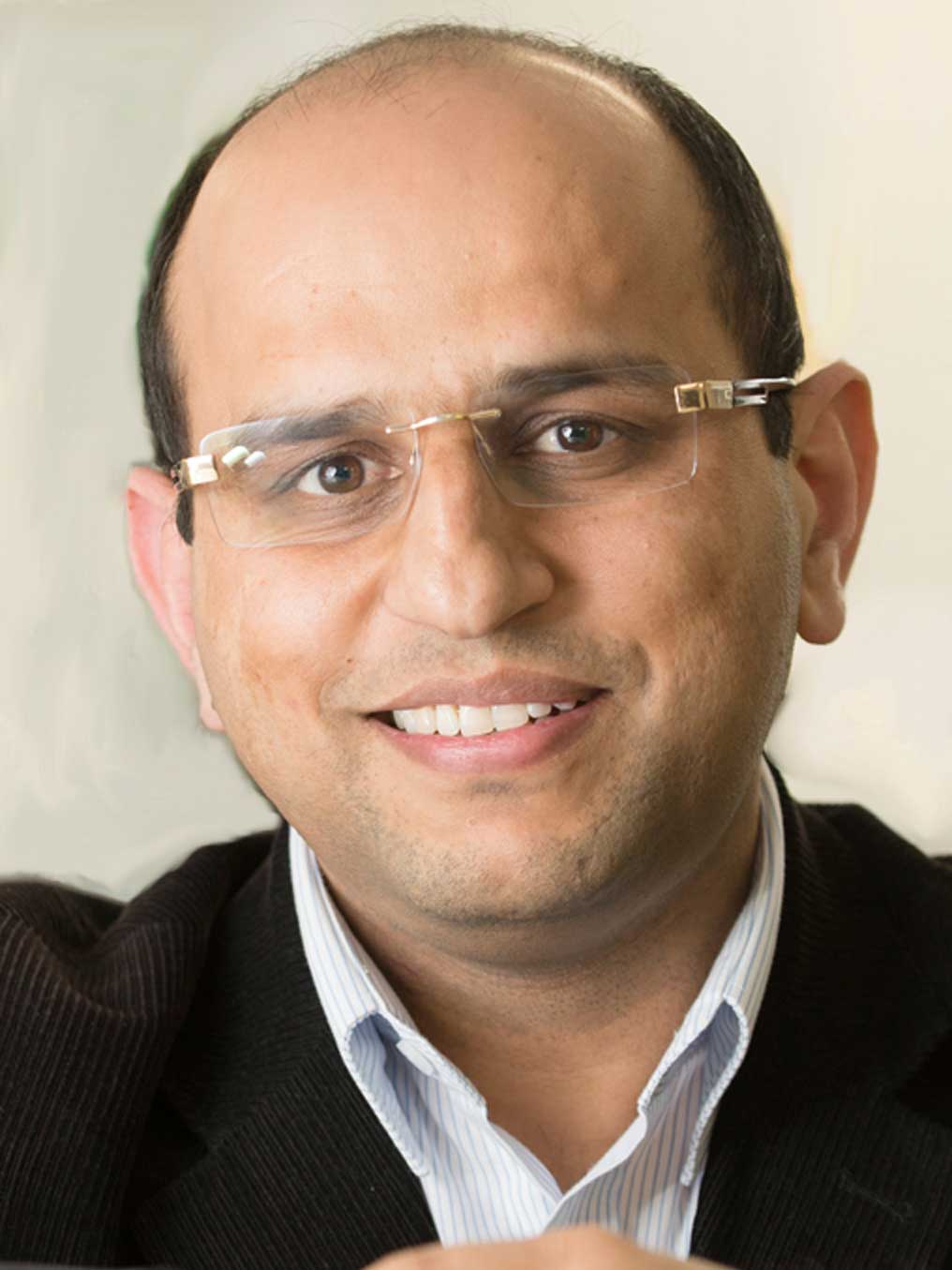
Ravinder Dahiya
Professor,
Electrical and Computer Engineering
Affiliated Researcher,
Dublin Innovation Institute
Research Focus
Flexible printed electronics, robotics (soft robotics), electronic skin, tactile sensing, haptics, intelligent interactive systems, wearable systems
Education
- PhD, Italian Institute of Technology, 2009
Honors & Awards
- Fellow, IEEE
- Fellow, The Royal Society of Edinburgh
- Life Member, Marie Curie Fellows Association
- Fellow, The Institution of Engineers in Scotland
- Microelectronic Engineering Young Investigator Award, 2016
Research Overview
Flexible printed electronics, robotics (soft robotics), electronic skin, tactile sensing, haptics, intelligent interactive systems, wearable systems

Bendable Electronics and Sustainable Technologies Group
The BEST lab is a multidisciplinary team working at the interface of printed electronics, material science, sensors, applied physics, robotics, and interactive systems. Research spans from the synthesis of nanostructures all the way to the integration (incl. heterogeneous) of electronic systems on large area, flexible, and non-conventional substrates.
Leveraging science and engineering for societal benefit, the research team aims to make a lasting positive impact through resource-efficient approaches for manufacturing of electronic systems and promotion of the responsible use of electronics – addressing global challenges like electronic waste.
Research Centers and Institutes
Department Research Areas
Selected Publications
- Guanbo Min, Gaurav Khandelwal, Abhishek Singh Dahiya, Shashank Mishra, Wei Tang, and Ravinder Dahiya, Multisource Energy Harvester on Textile and Plants for Clean Energy Generation from Wind and Rainwater Droplets, ACS Sustainable Chemistry & Engineering 2024 12 (2), 695-705
- Gaurav Khandelwal, Guanbo Min, Xenofon Karagiorgis, Ravinder Dahiya, Aligned PLLA electrospun fibres based biodegradable triboelectric nanogenerator, Nano Energy, Volume 110, 2023
- Markellos Ntagios, Habib Nassar, Ravinder Dahiya, Closed-loop direct ink extruder system with multi-part materials mixing, Additive Manufacturing, Volume 64, 2023
- G. Khandelwal, R. Dahiya, “Self-Powered Active Sensing based on Triboelectric Generator,” Advanced Materials, 2200724, 2022.
- A. S. Dahiya, A. Zumeit, A. Christou, R. Dahiya, “High performance n-channel printed transistors on biodegradable substrate for transient electronics,” Advanced Electronic Materials, 2200098, 2022. (DOI: 10.1002/aelm.202200098).
- E. S. Hosseini, M. Chakraborty, R. Dahiya, “Porous Elastomer based Wide Range Flexible Pressure Sensor Device for Autonomous Underwater Vehicles,” IEEE Sensors Journal, Vol. 22(10), pp. 9914 – 9921, 2022. (DOI:
10.1109/JSEN.2022.3165560). - R. Dahiya, “Editorial Introduction to the First Issue,” IEEE Journal on Flexible Electronics, 2022. (DOI: 10.1109/JFLEX.2022.3162128)
- A. S. Dahiya, A. Christou, J. Neto, A. Zumeit, D. Shakthivel, R. Dahiya, “In Tandem Contact-Transfer Printing for High-Performance Transient Electronics,” Advanced Electronic Materials, 2200170, 2022 (DOI: 10.1002/aelm.202200170)
- M. Chakraborty, J. Kettle, R. Dahiya, “Electronic Waste Reduction through Devices and Printed Circuit Boards designed for Circularity,” IEEE Journal on Flexible Electronics, 1(1), pp 4-23, 2022. (DOI:10.1109/JFLEX.2022.3159258) (invited)
- P. K. Murali, A. Dutta, M. L. Gentner, E. Burdet, R. Dahiya, M. Kaboli, “Active Visuo-Tactile Interactive Perception for Accurate Object Pose Estimation in Dense Clutter,” IEEE Robotics and Automation Letters, Vol. 7 (2), pp 4686-4693, 2022.
- F. Nikbakhtnasrabadi, E. S. Hosseini, S. Dervin, D. Shakthivel, R. Dahiya, “Smart Bandage with Inductor-Capacitor Resonant Tank Based Printed Wireless Pressure Sensor on Electrospun Poly-L-Lactide Nanofibers,” Advanced Electronic Materials, 2101348, 2022. (DOI: 10.1002/aelm.202101348)

Feb 26, 2026
The Technical Challenges of Integrating Robots into Human Society
ECE Professor Ravinder Dahiya published “Cognizant and Socially Aware Robotics” in Computer magazine. This article examines the current state of robotics and forecasts the near-term and midterm future landscape toward achieving humanoid robots capable of mimicking human perception, intelligence, and emotion.
Feb 26, 2026
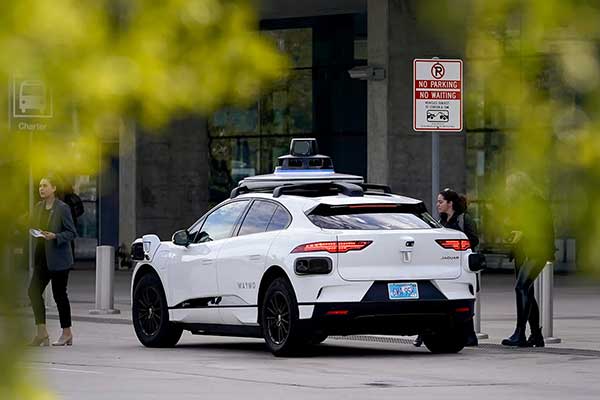
New Biomimicry Technology Can Increase Safety in Autonomous Vehicles
New research from Electrical and Computer Engineering Professor Ravinder Dahiya has the potential to make self-driving cars safer. This new technology mimics how a human retina analyzes images by using synaptic transistors, devices used to simulate neural pathways, that significantly reduces processing time to machines like autonomous vehicles.
Jan 29, 2026
Inside the Unforeseen Dangers of Dissolvable Medical Devices
ECE Professor Ravinder Dahiya was featured in the Medical Device and Diagnostic Industry (MD&DI) article “Inside the Unforeseen Dangers of Dissolvable Medical Devices.”
Dec 22, 2025
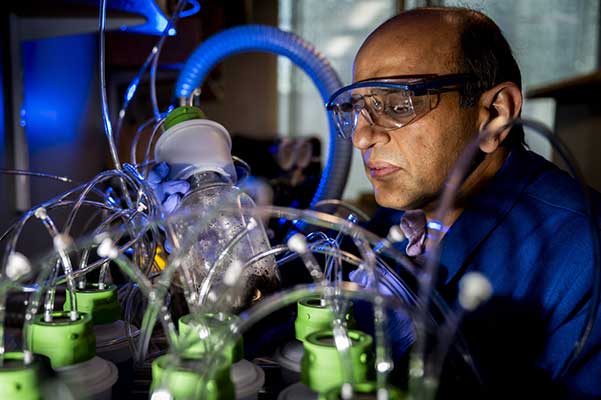
The Environmental Reality of Dissolvable Electronics
ECE Professor Ravinder Dahiya discovered that some biodegradable electronics fail to fully dissolve and instead break down into harmful microplastics that can persist in and damage the environment for years.
Nov 14, 2025
Built to Last: Rethinking Electronics for a Circular Future
ECE Professor Ravinder Dahiya was featured in the IEEE Technology for a Sustainable Climate article “Built to Last: Rethinking Electronics for a Circular Future.”
Sep 23, 2025
2025 Stanford University Annual Assessment of Author Citations
The following COE professors are among the top scientists worldwide selected by Stanford University representing the top 2% of the most-cited scientists with single-year impact in various disciplines. The selection is based on the top 100,000 by c-score (with and without self-citations) or a percentile rank of 2% or above.
Sep 17, 2025
Sustainable Solutions for Semiconductor Wastewater
ECE Professor Ravinder Dahiya’s research on “Semiconductor Manufacturing Wastewater Challenges and the Potential Solutions via Printed Electronics” was published in iScience.
Aug 26, 2025
Paving the Way for Printed Flexible Electronics
ECE Professor Ravinder Dahiya’s research on “Site-Specific Growth and Printing of Nanowires for Resource Efficient Fabrication of Flexible Electronics” was published in Small.
Aug 26, 2025
New Roadmap Article Lays Out a Path for Future AI-Powered Robots
ECE Professor Ravinder Dahiya published “A roadmap for AI in robotics” in Nature Machine Intelligence.
Jul 30, 2025
Uncovering Byproduct Concerns in Eco-Friendly Electronics
Professor of electrical and computer engineering Ravinder Dahiya and Sofia Sandhu, a postdoc working in Dahiya’s group, recently published a paper “End-of-Life usefulness of degradation by products from transient electronics” in npj Flexible Electronics.